Foresight Nanotech Institute Logo
Image of nano

Archive for the 'Atomically Precise Manufacturing (APM)' Category

Does quantum tunneling complicate theoretical studies of nanotechnology?

Posted by Jim Lewis on June 16th, 2011

Does the recent discovery that quantum tunneling controls a chemical reaction of a carbene complicate theoretical studies of nanotechnology, especially of diamond mechanosynthesis?

Theoretical work establishes structural stability of nanoscale diamond structures

Posted by Jim Lewis on June 10th, 2011

Computational studies show that small diamond structures of the type that might serve as nanoparts in diamondoid molecular machinery are structurally stable.

Computational circuit built from 74 small DNA molecules (with video)

Posted by Jim Lewis on June 9th, 2011

A biochemical circuit built from 74 small DNA molecules demonstrates an approach that may enable embedded control of molecular devices.

Foresight@Google: Full Program of Speakers posted!

Posted by Christine Peterson on June 2nd, 2011

We are proud to announce our final conference program for Foresight@Google‘s 25th Anniversary Conference Celebration, held June 25-26 in Mountain View, CA.  For $50 off registration use code: NANODOT This weekend – full of plenary talks, panels, and breakout sessions – is a unique opportunity to be stimulated, enlightened and inspired by direct interaction with [...]

Computer simulation of evolution of primordial molecular machine

Posted by Jim Lewis on June 1st, 2011

A Monte-Carlo simulation shows that a simple self-replicating RNA-like molecule in a specific protective environment could evolve the ability to translate a genetic code to produce peptides.

TODAY is the last day for early rate on Foresight@Google

Posted by Christine Peterson on May 17th, 2011

Midnight tonight Pacific time is the deadline for the early registration rate on Foresight@Google, our 25th Anniversary Conference and Celebration. Check it out here: http://foresight.org/reunion Past participants have said: “This is mind candy for my soul. Having attended for two years now, this event stands alone in my mind as an opportunity to explore new horizons, [...]

A modular molecular composite nanosystem for solar power

Posted by Jim Lewis on May 17th, 2011

A bacterial virus called M13 was genetically engineered to control the arrangement of carbon nanotubes, improving solar-cell efficiency by nearly one-third.

New software aids design of 3-D DNA structures

Posted by Jim Lewis on May 12th, 2011

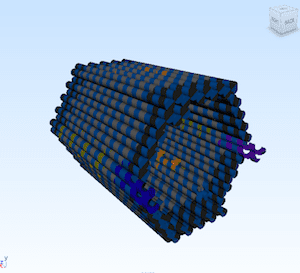
New software for scaffolded DNA origami makes it easier to predict what shape will result from a given DNA template.

Much faster directed evolution of proteins could speed development of molecular machine systems

Posted by Jim Lewis on April 25th, 2011

Phage-assisted continuous evolution of proteins is roughly a hundred times faster than conventional laboratory evolution of proteins, perhaps speeding the development of components for molecular machine systems.

DNA nanotechnology builds 3D forms with complex curves (includes video)

Posted by Jim Lewis on April 20th, 2011

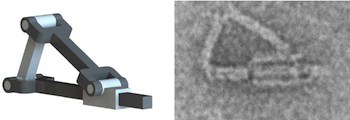
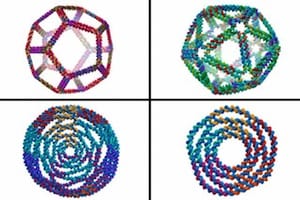
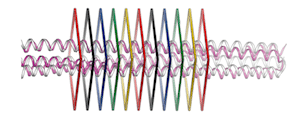
The capabilities of scaffolded DNA origami procedures have been expanded to construct arbitrary, two- and three-dimensional shapes.

Real-time monitoring of atomic force microscope probes

Posted by Jim Lewis on April 19th, 2011

Real-time monitoring of atomic-force-microscope probes to adjust for wear may speed up and improve the accuracy of measurements and manipulations done with AFMs.

High-resolution structure reveals versatility of RNA nanotechnology

Posted by Jim Lewis on April 17th, 2011

A high-resolution crystal structure of a small square made by self-assembly of RNA molecules reveals each corner of the square to have a unique structure.

Confining enzymes in specially engineered nanoporous materials may advance nanotechnology

Posted by Jim Lewis on April 13th, 2011

Engineering both the pore size and chemical functionality of nanoporous materials affects both the secondary structure and the catalytic activity of the enzymes confined in the nanopores.

Mechanical manipulation of silicon dimers on a silicon surface (video)

Posted by Jim Lewis on March 23rd, 2011

UK scientists use mechanical force to manipulate silicon dimers on a silicon surface as a first step toward automated atomically precise manufacture of three-dimensional nanostructures.

AFM visualization of molecular robot moving along DNA scaffold (with video)

Posted by Jim Lewis on March 21st, 2011

Researchers in the UK and Japan use atomic force microscopy to visualize a DNA molecular robot moving along a 100-nm DNA track.

Positional control of chemical reaction a step toward advanced nanotechnology

Posted by Jim Lewis on March 11th, 2011

A step toward advanced nanotechnology has been achieved by using attachment to a surface and confinement by surrounding molecules to make two molecules react to form a product that would not form if they were free to react in solution.

Atomically precise graphene nanotechnology

Posted by Jim Lewis on March 8th, 2011

Sputtering a pattern of zinc atoms on a graphene surface, followed by an acid rinse to remove the zinc, also removes exactly one atomic layer of graphene from where ever the graphene was covered with zinc atoms, forming a pattern on the graphene surface that is atomically precise in the vertical dimension. Resolution in the horizontal dimensions is determined by the mask used to sputter zinc.

Protein folding is a quantum transition

Posted by Jim Lewis on March 3rd, 2011

Chinese scientists demonstrate that protein folding is a quantum transition between torsion states on a polypeptide chain.

DNA molecular robots learn to walk in any direction along a branched track

Posted by Jim Lewis on February 23rd, 2011

In yet another in a long list of improvements to DNA based molecular machines, DNA molecular robots learn to walk in any direction along a branched track.

Improving upon self-assembly

Posted by Jim Lewis on February 6th, 2011

A new technique is reported to use templates to build synthetic molecules the size of proteins by precisely stringing together smaller molecules using an approach based upon the vernier scale.